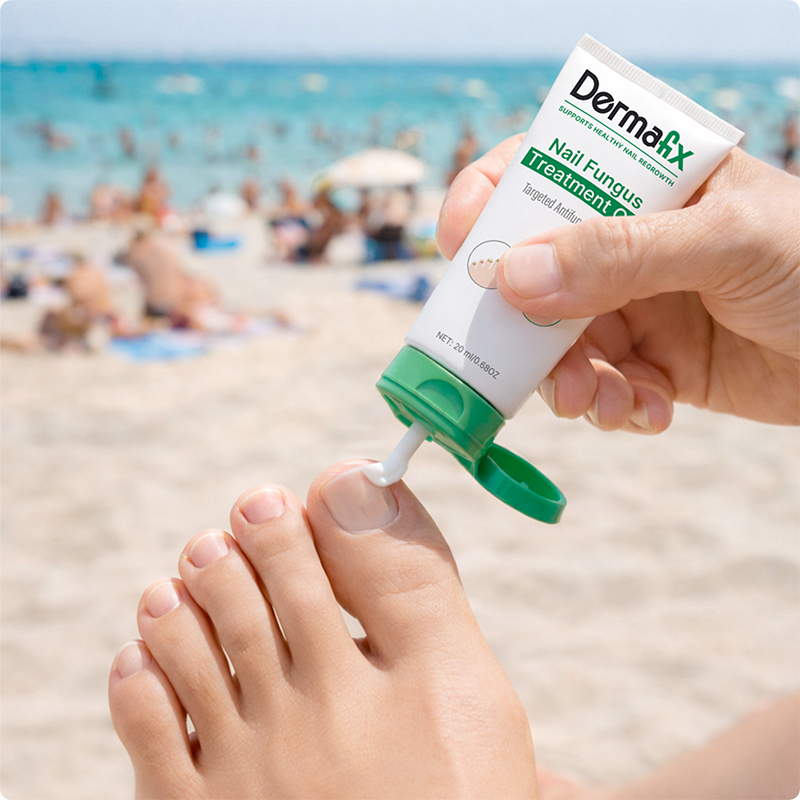
Dermafix Gel
Original price was: 34,99 €.14,99 €Current price is: 14,99 €.
Description
Why nail fungus is so stubborn – the underlying problem is called the keratin barrier
At first glance, nail fungus seems like a minor cosmetic nuisance: a nail becomes yellowish, dull, thicker and crumbly. In practice, however, it is one of the most stubborn ‘everyday infections’ because the site of the infection is biologically difficult to reach. The nail consists largely of keratin. Keratin is a fibrous protein that is arranged in a densely packed, layered structure. This structure makes nails hard, stable and water-repellent – exactly what we want in everyday life. However, this protective function is an obstacle to treatment: many active ingredients simply cannot penetrate deep enough to reach the fungus.
Fungi that attack nails use keratin as a food source. They grow slowly but steadily. And because nails also grow slowly, the effects of any treatment are not visible within a few days, as with a pimple, but often only after weeks or months. This causes frustration and is the most common reason why people give up too soon. If you want to successfully treat nail fungus, you need a plan that combines two things: an active ingredient that puts the fungus on the nail ‘under pressure’ and a consistent routine that is followed long enough until the damaged part has grown out.
What is Dermafix Nail Fungus Gel?
Dermafix Nail Fungus Gel is an externally applied gel that is marketed as an over-the-counter solution for signs of nail fungus. The basic idea is to use a formula that not only remains on the surface, but is designed to penetrate the nail area better thanks to an oil-based carrier structure. Dermafix positions itself as a mixture of antimicrobial components and nourishing, regeneration-oriented ingredients.
It is important to note that Dermafix is not a ‘tablet approach’ that works through the bloodstream, but rather a local approach. This means that the burden on the rest of the body tends to be lower, but the result depends more on how well the product actually reaches its target and how consistently it is applied.
Understanding nail fungus – what happens in the nail?
To understand what a gel can actually do, it helps to take a quick look at the process of onychomycosis. The fungus often starts at a small weak point: micro-injuries, pressure points in the shoe, torn nail edges or a permanently moist environment. It often starts at the edge or tip. The fungus then settles between the nail plate and the nail bed and slowly spreads inwards. The nail becomes increasingly cloudy, discoloured, thickened and brittle.
The visible nail is, so to speak, the ‘record’ of what happened in the nail bed weeks before. If you see an improvement today, it is the result of consistent treatment in the past – and not just yesterday or the day before. This is precisely why treatment schedules for nail fungus must always be long-term. A reasonable expectation is that you combat the growth and support healthy regrowth – and the visible result will come when the nail grows back.
The active principle of Dermafix explained
Dermafix works (as it is positioned) with a multi-stage mechanism that can be translated into three tasks:
Firstly: transport and penetration. If the active ingredients do not reach their destination, nothing else matters. Oil-based carriers (as found in many nail oils) can have better ‘wetting’ properties and different diffusion behaviour on keratinised structures compared to purely water-based solutions. You can imagine the nail as very tightly packed layers: there are tiny gaps and channels, but they are limited. A carrier that ‘adheres’ well and remains on the nail for a long time has a higher chance of penetrating these micro-areas.
Second: Antimicrobial environment. Many over-the-counter products rely on substances that alter the environment in such a way that fungi find it more difficult to multiply. This is not an ‘instant kill’ as with some drugs, but rather a continuous pressure on growth. In the case of nail fungus, this constant pressure is often the decisive factor.
Thirdly: care and regeneration. Even if the fungus is slowed down, the nail is often dry, brittle and structurally weakened. Care components are not just ‘cosmetics’, but can help to reduce cracks and breaks that give the fungus new entry points. In addition, a better-cared-for nail bed can stabilise regrowth.
Ingredients – what should each component do?
Dermafix is typically described as a combination of several components. For a meaningful evaluation, it is more helpful to understand the functions than to simply list the names. With nail fungus, there is no single ‘button’ to press. It’s more like a game of chess: you want to take away the fungus’s territory over time and at the same time give the nail better conditions again.
Colloidal silver is positioned as an antimicrobial in many care concepts. This means that it is supposed to help reduce the microbial load on the surface and in the adjacent areas. If the environment becomes more ‘unfriendly’ overall, the fungus will find it harder to spread. The point is: with nail fungus, it is rarely a matter of eradicating everything within 24 hours. It is about permanently slowing down growth until the affected structure has grown out.
Tea tree oil is an essential oil that is traditionally used for skin problems. Many people know it as a ‘strong’ oil that has a characteristic smell and often appears in products for treating spots, foot odour or fungal problems. In practice, it is a double-edged sword: it can be a useful ingredient, but it can also irritate sensitive skin. That is why it always makes sense to start cautiously with such products and observe how the skin reacts.
Emu oil is often described as a carrier oil. This is not accidental in nail products, but strategic. Imagine you have two tasks: first, to get an active ingredient onto the nail, and second, to ‘hold’ it there so that it has longer contact. Oils can help with this because they wet the nail well and do not evaporate immediately.
Whether this really penetrates deeply enough in individual cases depends heavily on the thickness of the nail and the stage of the condition.
Squalane is a lipid-like skincare ingredient. It can be thought of as a ‘soft’ component that binds moisture and makes the area around the nail more supple. This is relevant for nail fungus because brittle, cracked structures open up new niches for the fungus. A well-groomed nail bed is therefore not only beautiful, but can also improve mechanical stability.
Vitamin E is a classic in skin care. It is often described as an antioxidant, i.e. a protection against oxidative stress. For nails, this means less ‘miracles’ and more solid groundwork: better care, less dryness, support for the barrier in the surrounding area.
Bacillus ferment is often used in cosmetics as a ferment-based care component. The idea is that ferments can improve the feel of the skin, make the surface appear smoother and support the overall care effect. For nails, this can mean a ‘better surface, less brittleness’.
Bottom line: the mix is designed to work on the environment and improve the mechanical side at the same time. This sounds less spectacular than ‘one thing kills everything’, but it is often the more realistic approach to nail fungus.
Application – how to set up a scientifically sound routine
The basic rule is simple: once a day, massage into dry, clean nails and stick with it. However, the difference between ‘applied’ and ‘well applied’ lies in the details. That’s why we’ve put together a robust routine that fits the biology of the problem:
Clean does not mean ‘sterile’, but free of grease, sweat and soap residue. If you apply it immediately after showering, dry thoroughly. Damp edges and spaces between the toes are a perfect breeding ground.
Dry means that the nail should not still be wet. Moisture dilutes the product and ensures that the contact is not as stable. Also, fungi like moisture, so don’t give them a bonus.
Target area means not just the centre of the nail, but the edges, transitions and the underside of the nail tip, as far as possible. Many fungi start at the edge or where the nail protrudes slightly.
Massaging in means: 30 to 60 seconds per nail is not excessive. You spread the gel, increase the contact area and give the product time to penetrate the microstructures.
Contact time means: let it absorb before putting on socks. If you wipe it off straight away, it’s like brushing your teeth and then immediately drinking cola: you’ve done something, but the effect is reduced.
Consistency means: every day. Fungi are not ‘lazy’. If you give them a break, they will take advantage of it.
What to expect and when – a realistic timeline without illusions
Nail fungus is slow because the nail is slow. Accepting this is a psychological win. Because then you measure success by the right indicators.
In the first 1 to 2 weeks, you will often see a change, especially at the nail bed: less dryness, less ‘rough’ feeling, better-groomed skin around the nail. This is not the end of the fungus, but an indication that the routine is working.
Between weeks 3 and 6, a narrow strip of clearer new growth may become visible at the nail root.
This is an important marker. It does not automatically mean that the fungus is gone, but it does mean that new keratin is forming under better conditions.
Between weeks 8 and 12, the difference often becomes more obvious as this clearer strip grows larger. The old, discoloured area slowly moves forward.
From month 4 onwards, it is often a matter of not becoming impatient: the nail looks ‘half good’, but the tip is still affected. This is exactly where many people give up – and this is exactly where the fungus likes to return.
From month 6 to 12, the phase begins in which a complete nail cycle becomes visible. In severe cases, this may be necessary in order to see a truly ‘new’ nail.
So if you are testing a product like Dermafix, 8 to 12 weeks is a fair minimum period to assess whether healthy new growth is developing at the base.
Hygiene and reinfection – why the environment is often more important than the choice of product
Many people treat nail fungus as an isolated problem: the nail is diseased, so apply the product. In reality, it is a systemic problem: nails, skin, shoes, socks, nail tools and daily moisture levels all play a part. If you only change one part, the rest can sabotage the result.
Here is a practical hygiene kit:
Change your socks every day. If you sweat a lot or do sports: even twice a day. Damp socks are a gym for fungus.
Air out your shoes and alternate them. Two pairs in rotation are better than one pair every day. Shoes need time to dry.
Dry your feet completely after showering. Don’t just ‘rub them down quickly’, but really dry them. Especially between the toes.
Clean your nail tools. Files, scissors, clippers – anything that comes into contact with your nails should be cleaned regularly. And if possible, don’t share them with others.
Wear flip-flops in communal showers. This may sound like something your grandmother would say, but it makes perfect biological sense.
If you do this consistently, you’ll reduce the likelihood of repeatedly infecting yourself.
Advantages of Dermafix in everyday life – translated into ‘Why it can be practical’
| Advantage | How you benefit | Why this matters for nail fungus |
|---|---|---|
| 🧴 Oil-based carrier approach | Gel stays on the nail well, can be massaged in | Contact time and wetting are key variables |
| 🌿 Combined active ingredient and care mix | Less ‘one-sided’, more of an all-round approach | Slows down fungus + stabilises structure |
| ⏱️ Once a day | Routine is realistically followed | Consistency beats ‘complicated programmes’ |
| 😌 Can be applied locally | No ‘full-body’ routine necessary | Fewer hurdles, more compliance |
| 🔁 Guarantee | You can test it at your leisure | Makes sense, because results take time |
| 📦 Available online | Quick availability for many | Typical for direct sales, but practical |
Experiences and reviews – what you can deduce from them without being blinded by hype
If a product receives a lot of positive feedback, this is initially a sign that some people are satisfied with it. However, the scientifically sound question is: what exactly are they satisfied with? And how was this measured?
There are three common successes with nail fungus:
Firstly: improved appearance through care and shine – this can happen quickly, even if the fungus is still present.
Secondly: clear regrowth at the base – this is a stronger biological marker.
Thirdly: complete regrowth – this is the ultimate goal.
A good test report separates these things. Otherwise, it gives the impression that ‘after two weeks, everything is gone’, even though after two weeks, often only the effects of care are visible. When reading reviews, look out for words such as ‘it became clearer at the root’, ‘after two months, I saw a stripe’, ‘after three to four months, the tip was still affected, but it was getting better’. These are typical patterns of realistic progress.
At the same time, there are typical patterns of failure:
irregular use,
too short a period of use,
poor hygiene,
too thick a nail that is difficult to penetrate,
or simply no fungus, but another cause.
Reputable or fake – a sober checklist
The term ‘fake’ is often confused. Therefore, here is a clear, practical classification:
Reputable in the sense of ‘not a scam’ can be recognised by the fact that ordering, payment, delivery, returns and contact methods are transparent. A money-back guarantee reduces the risk for consumers and is a positive sign.
Non-reputable in the sense of ‘exaggerated’ can be recognised by biologically implausible promises. Nail fungus takes time to treat. Anyone who suggests ‘immediate’ results is at least marketing-heavy.
And then there is the third level: ‘Will it work for me?’ This is not a question of reliability, but of suitability. If the infection is very deep or the nail is extremely thickened, any purely external solution is more difficult. In this case, additional measures (e.g. professional removal) can significantly increase the chances of success.
In this logic, Dermafix acts like a typical, heavily marketed, but basically normal care product: it is not automatically a scam, but it is also no substitute for medical clarification in severe cases.
DM and Rossmann – what this really means
Many people use chemists as a seal of quality. This is understandable: if it’s on the shelf, it feels more ‘proven’. But product range and reliability are not identical. Chemists do not list every product, especially if a brand focuses on direct sales and online marketing. The online route is often more profitable and quicker to scale for manufacturers.
Therefore,
‘not available at DM/Rossmann’ is more an indication of distribution than proof of quality. The fair statement for the test report is: Dermafix is mainly offered online, while similar products in drugstores are often other brands.
Höhle der Löwen – why you should treat this fairly in the test report
‘Höhle der Löwen’ is a strong anchor of trust in Germany. That’s why it often appears as a search term in online marketing. For a clean test report, the rule is: only make claims if they can be clearly proven. Otherwise, use neutral wording: there is no reliable evidence that the product was presented there. This protects you in terms of content and makes you appear more reputable.
Who is Dermafix particularly suitable for?
It is particularly suitable for people who:
act early and do not wait until the nail is extremely thickened,
prefer a simple daily routine,
are willing to accept 8 to 12 weeks as a minimum test period,
and do not ignore hygiene.
It is less suitable for people who:
expect an ‘instant solution’,
have very thick and hard nails,
or have symptoms that should be medically evaluated (pain, inflammation, severe spread, risk factors such as diabetes).
Differential diagnosis – not every nail change is nail fungus
An important scientific point for any ‘nail fungus’ story is that nails can look strange for a number of reasons. If you mention this in the test report, it automatically makes it seem more credible because you are not pretending that every discolouration is clear-cut.
Common alternatives are:
Mechanical trauma: Tight shoes, long runs, bumping or constant pressure can discolour or thicken the nail. Sometimes, small haemorrhages can even cause a dark spot.
Nail psoriasis: Psoriasis can cause nails to become pitted, appear yellowish or partially detach. To the untrained eye, this can easily be mistaken for a fungal infection.
Eczema and inflammation: Chronically irritated skin around the nail can affect the nail structure.
Deficiencies or metabolic problems: Certain changes can also have systemic causes, although this is less common than pressure and fungal infections.
Why this is important: If someone does not have a fungal infection, then an antifungal gel cannot ‘solve the problem’, but can only provide care at best. This is not ‘proof that it is fake’, but an indication that the initial assumption was wrong. If you are unsure, you can have it medically tested. For a test report, it is sufficient to mention the point clearly without causing alarm.
Penetration and nail thickness – when a gel reaches its limits
The bottleneck with nail products is almost always the nail plate. The thicker, harder and more multi-layered the nail is, the less gets through. This is physics and biology, not marketing.
There are a few practical tips for when a purely external solution becomes more difficult:
The nail is extremely thickened and feels ‘like horn’.
The surface is heavily layered and crumbly.
The infestation is located very far back towards the nail root.
The nail has clearly detached from the nail bed, creating a larger ‘hollow’.
In such cases, it may be advisable to have the nail plate professionally treated to shorten the path for external treatment. This is not a ‘trick’ but a mechanical optimisation: when the barrier becomes thinner, the chance of active ingredients reaching their destination increases. Those who do not want to do this can still try, but should significantly lower their expectations in terms of speed.
Side effects and tolerability – what is realistic with such formulas?
Strong side effects are rare with over-the-counter care products, but irritation is possible. In short, anything that has an ‘antimicrobial’ effect or contains essential oils can irritate the skin barrier in sensitive people.
Typical reactions to look out for:
Redness around the nail bed
Burning or itching
Dry, flaky skin around the nail
If this happens, the first step is usually to use less product, less often, or take a short break – and then slowly start again. If it becomes severe or does not go away, you should not ‘persevere’. A well-groomed, non-irritated nail bed is part of the success.
90-day plan – how to test Dermafix in a structured way instead of ‘by feel’
Many people test products in a haphazard way: sometimes they use it, sometimes they forget, then they judge it after two weeks. A structured test is fairer and gives you better data.
Weeks 1–2: Establish a routine
Goal: Use every day, without exception. Focus on drying thoroughly and applying correctly. In this phase, you are not evaluating whether the fungus has gone, but whether the application fits well into your everyday life and whether your skin tolerates the product.
Weeks 3–6: Observe markers
Goal: Pay attention to new growth at the nail root. Take a photo once a week in the same light and at the same angle. This may sound nerdy, but it is extremely helpful because our memory is poor when it comes to slow changes.
Weeks 7–12: Objectify progress
Goal: You want to see if the clear area is growing and if the discoloured zone is moving forward. At the same time, maintain consistent hygiene routines (shoes, socks, tools). In this phase, ‘sticking with it’ is the main factor.
After 90 days: Decision
If you see clear regrowth and the direction is right, it is usually worth continuing until the affected part has grown out. If you don’t see any clear regrowth, you can consider: Was it really fungus? Was the application consistent? Is the nail too thick? Are additional measures needed?
This turns ‘experience’ into a comprehensible test.
Short FAQ in test report style
Can I also use Dermafix preventively?
Prevention of nail fungus is primarily a matter of hygiene. A product can provide additional care, but the most important thing is to keep your nails dry, change your shoes, change your socks regularly and avoid communal showers.
Can I use nail varnish at the same time?
Mechanically, this is often unfavourable because varnish forms an additional barrier. If you really want to use nail polish, it makes more sense to treat the nail consistently and minimise the amount of polish used so that contact with the nail is not blocked.
What if only one nail is affected?
This is often a good starting point because it is easier to monitor the progress. Nevertheless, tools and hygiene remain important to prevent it from spreading to other nails.
Is a ‘smell’ or ‘tingling’ normal?
A slight smell may come from essential components. Tingling may occur, but should not be severe or permanently painful. The limit is: if the nail bed becomes irritated, it is better to take a break and use a more cautious dosage.
The most common mistakes – and simple countermeasures
Mistake: Irregular application.
Countermeasure: Set a fixed time (e.g. in the evening).
Mistake: Only applying to the ‘top’.
Countermeasure: Include the edges and underside, as far as possible.
Mistake: Stopping too soon.
Countermeasure: continue for at least 8 to 12 weeks and then assess based on regrowth.
Mistake: ignoring shoes and tools.
Countermeasure: change shoes, socks regularly, clean tools.
Mistake: no diagnosis.
Countermeasure: seek medical advice if unsure or if symptoms are severe.
Evaluation
Dermafix Nail Fungus Gel relies on a logic that is crucial for nail fungus: penetration, contact time and environment. An oil-based carrier idea suits the problem that the nail is a hard keratin barrier. This is supplemented by antimicrobial components and nourishing building blocks that are intended to stabilise the environment.
Whether it works for you will not be decided in two days, but over weeks. A fair test period is at least 8 to 12 weeks, preferably longer, because nails grow slowly. Those who remain consistent, take hygiene seriously and measure success by ‘clear results’ have the best chance of seeing visible help from an over-the-counter approach.
Related products
-
Sale!

Halo Grow Hair Spray
Original price was: 49,99 €.29,99 €Current price is: 29,99 €. Order HALO GROW with a discount (Official website) -
Sale!

Blood Vitals Glucose Monitor
Original price was: 39,95 €.25,95 €Current price is: 25,95 €. Order BLOOD VITALS (discounted price) -
Sale!

Wellnee Knee Brace
Original price was: 65,85 €.25,95 €Current price is: 25,95 €. Order WELLNEE KNEE BRACE (discounted price) -
Sale!
Wellnee herbal knee patch
Original price was: 55,96 €.17,95 €Current price is: 17,95 €. Order WELLNEE (discounted price)


Reviews
There are no reviews yet.